Check out the preprint on bioRxiv: Ramm, Weatherly and Toettcher, bioRxiv 2026.06.19.733436
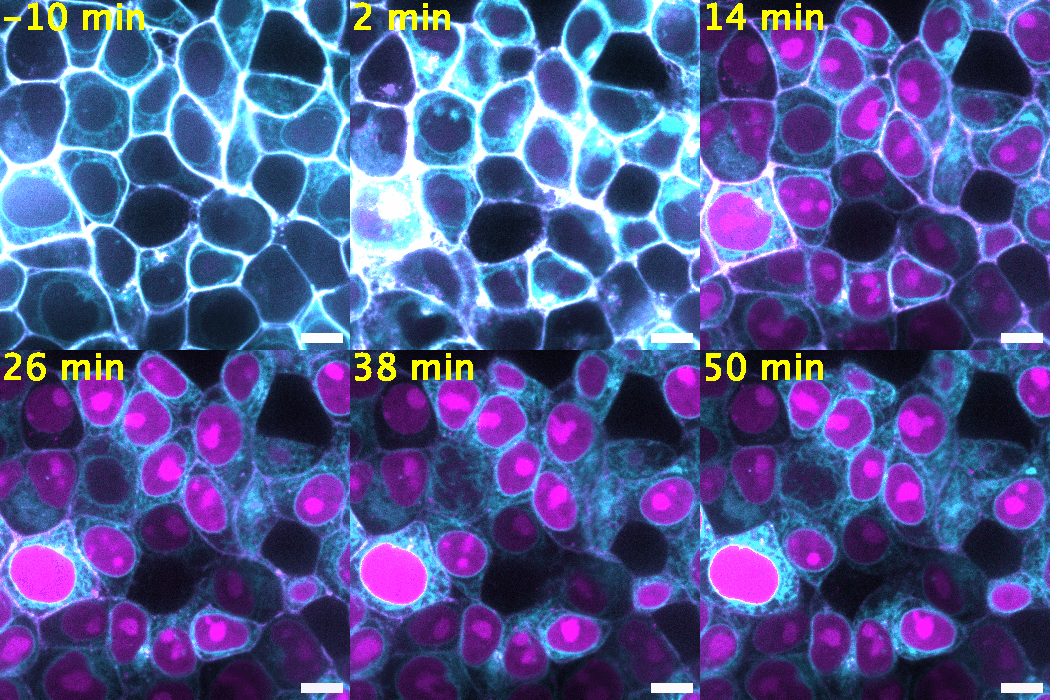
Very excited to announce that Beatrice's paper with Jared Toettcher from her time as a Fellow at Princeton's Center for the Physics of Biological Function is finally out as a preprint! We designed modular, live-cell biosensors for extracellular protease activity that we call eNRGies (engineered neuregulin reporters as general indicators for extracellular shedding). eNRGies sensors translate extracellular cleavage events into nuclear translocation of a fluorescent protein. We were motivated by the beautiful ERK activation waves observed in various tissues, which depend on ADAM17, a cell-surface protease that cleaves EGFR ligands into their active, soluble form. Wondering whether ADAM17 would show dynamics, too, we set out to develop a biosensor for its activity. The design was inspired by regulated intramembrane proteolysis (RIP): protease activity liberates a bulky, extracellular domain (mEGFP), and then the remaining transmembrane protein is cleaved by γ-secretase, releasing the ICD from the membrane, which finally translocates into the nucleus. We prototyped the biosensor using TEV protease, and systematically optimized all biosensor domains. The result was a biosensor in which nuclear translocation is evident within mere minutes of addition of TEVp to the medium. Using cellpose to segment nuclei and cell membranes, the biosensor activity can be quantified using nuclear-to-membrane fluorescence intensity ratio, a metric that does not require normalization and can thus be used both in end-point assays and to measure protease dynamics over time. eNRGies can be adapted for various recombinant proteases using known cleavage sites; we have tested Enterokinase, FXa and MMP-9. It is also modular with respect to the extracellular and intracellular domains: we can swap out the FusionRed for other fluorescent proteins or a HaloTag. Returning to our goal to visualize ADAM17 activity, we found that eNRGies with a cleavage site of the EGFR ligand TGFα can reliably report on ADAM17 activity. Using this sensor we found that ADAM17 is transiently activated during mitosis in HEK293T. When we expressed eNRGies in the breast epithelial cell line MCF10A and stimulated those cells with the EGFR ligand EGF, we found that ADAM17 shows dynamic pulses that are correlated with a preceding pulse of ERK activity.